
THE BBC WHITE MARCHES
Is it coincidence that a building adorned with pedophile sculptures should be found to house a nest of pedophiles?
On 14th June 2021, in the aftermath of a huge anti-lockdown protest in London, a senior BBC reporter named Nick Watt was chased out of Whitehall, to taunts of ‘traitor’, ‘scum’, and ‘liar’.
‘Shame on you! Shame on you!’ chanted the protesters as Watt scooted like a frightened rabbit behind the police barricades blocking access to Downing Street.
In the following days, a high-level meeting at the BBC is said to have taken place to discuss the problem — that the Corporation’s hold over a significant section of the British public appeared to have been broken.
No one should have been surprised. Over the previous sixteen months the vast, sprawling apparatus of the coercively-funded, government-controlled British Broadcasting Corporation had acted as a megaphone for incessant fear-propaganda about an ‘emergency’ which was used to seize dictatorial power and strip British citizens of their livelihoods and fundamental rights.
A coalition of journalists, media and public relations professionals, Journalists Against Covid Censorship, drew up a summary of the failures of the legacy media to provide citizens with impartial information when they needed it most. It’s a pretty extensive rap-sheet. In common with the rest of the legacy media in the UK, the BBC had published fear-inducing and sometimes inaccurate news coverage, without providing proper context for statistics on Covid-19 ‘cases’ and deaths; it had failed to provide a balanced account of the cost and impact of the lockdown policy, while undermining initiatives such as the Great Barrington Declaration that offered alternatives to the government’s COVID-19 mitigation policies. It suppressed coverage of alternative treatments such as ivermectin, fluvoxamine and hydroxychloroquine, and failed to enquire into the methodology of the PCR process, particularly its suitability as a diagnostic test and the thresholds at which the tests are run. It commissioned hit-pieces targeting scientists who dissented from the dominant COVID-19 narrative, downplayed or ignored instances of adverse reactions to the vaccines, including death, failed to report on or condemn the routine censorship by tech giants of dissenting voices and opinions, and helped to foster a hostile environment for people who chose not to take the Covid-19 vaccine.
These are not trivial charges, and they apply most sharply to the BBC, as a public service broadcaster, whose performance during the pandemic amounts to an utter dereliction of duty and its weaponisation against objectivity and truth. The Corporation had revealed itself as a proto-totalitarian instrument of propaganda and censorship.
In September 2020, a huge crowd packed Trafalgar Square chanting and singing — “We are the 99%!” “You can stick your poison vaccine up your arse!” and “Take down the BBC!”
The protests were quickly stifled by a second national lockdown over the winter, but came roaring back in April of 2021, rapidly growing into the biggest demonstrations the capital has ever seen. The BBC monkeys covered their ears and eyes and pretended everything in the paralysed capital was normal. When it acknowledged them at all, it claimed that the marchers consisted of a tiny minority of ‘right-wing conspiracy theorists’. A few hundred of them, that’s all. A few thousand at most.
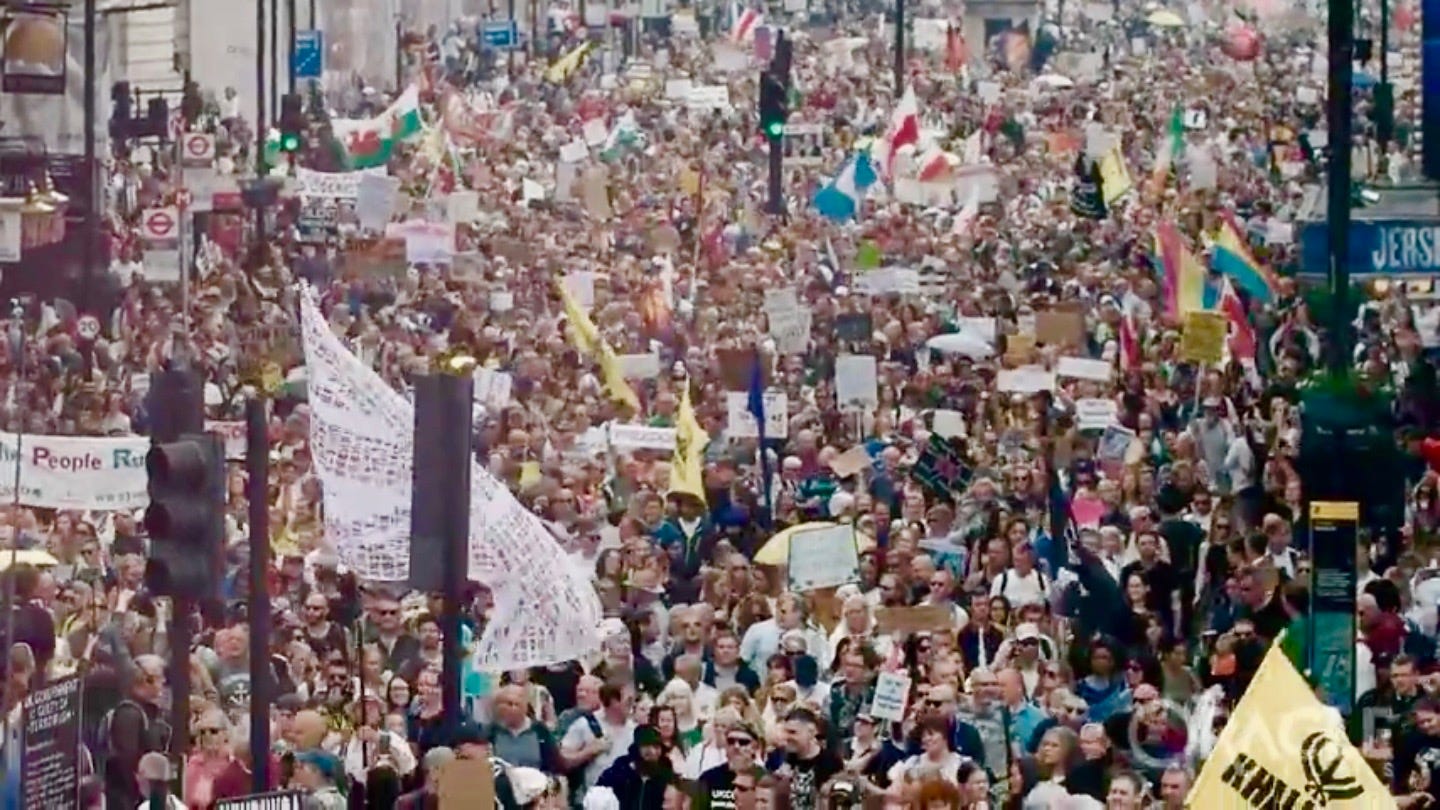
Lies don’t come much more brazen than that: footage of the crowds in Trafalgar Square, Pall Mall, Whitehall and Hyde Park on weekends in May clearly showed hundreds of thousands of people of all ages, ethnicities and walks of life; on June 12th, half a million by conservative estimates; on June 26th, central London was overwhelmed by a vast tide of people flooding in from all quarters of the kingdom, despite the extension of travel bans. It didn’t look like ‘a few’ anything. It looked more like a cross-section of the entire British public. It looked like everyone.
But anger against the BBC goes deeper than its role in spreading the government’s anti-scientific COVID narrative. From September 2020 onwards, anti-lockdown protests and their aftermaths included subsidiary demonstrations outside Broadcasting House, the BBC’s headquarters in Portland Place in the West End of London, as well as at regional offices in other cities. These were not riots, but demonstrations of focused anger and disdain. The BBC, naturally, did not report on them.
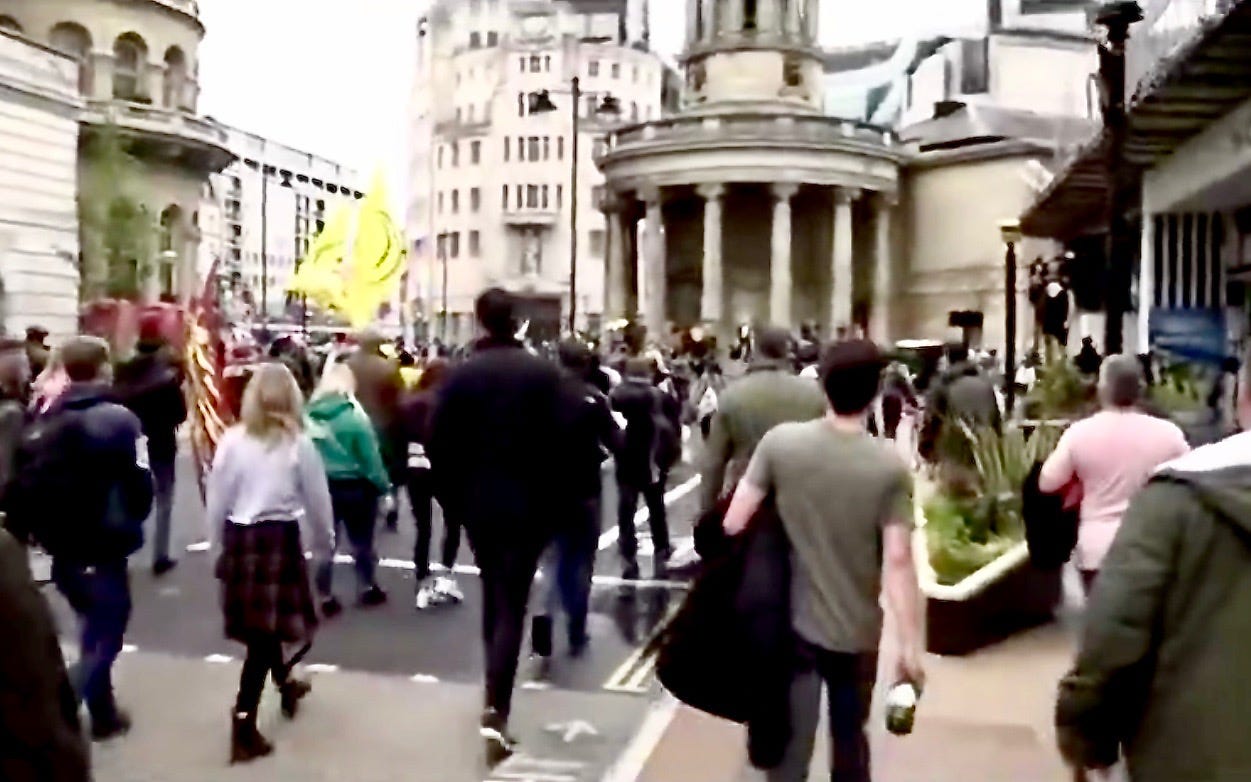
“Shame on you!” the protesters chanted, beneath the strange statue presiding over the main entrance to the original building.
“Take it down! Take it down!”
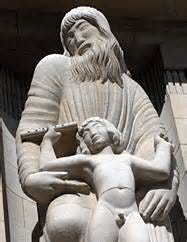
The statue is part of a series by Eric Gill, a British artist of considerable reputation when the building was opened in 1932 — a reputation posthumously destroyed when Fiona MacCarthy’s 1989 biography drew on Gill’s own diaries to reveal the sculptor’s serial incestuous pedophilia. Gill had journaled details not just of his extramarital affairs, but of his sexual abuse of two of his daughters and one of his sisters. Even his dog was not safe from his attentions.
This knowledge makes it impossible to look at the Gill sculptures commissioned for Broadcasting House without another narrative emerging. The post-modernist insistence that an artist’s life-history has nothing to do with his work completely breaks down in a case like Eric Gill. The biographical information is, absolutely, a key to understanding these subversive artworks.
Posterity may have quietly discarded the memory of Gill as an artist; but the crowds chanting outside the building remember certain things which the BBC, and the British establishment as a whole, would prefer us all to forget. For instance, they remember the names of some of those who used to stroll in beneath that statue, which presides over the main entrance like a tutelary deity.
Jimmy Savile, for one — that is, Sir James Savile, Officer of the Most Excellent Order of the British Empire, Knight Commander of the Pontifical Order of Saint Gregory the Great, philanthropist, disk-jockey, entertainer, charitable fund-raiser and volunteer, serial rapist, pedophile and necrophiliac, friend and confidant of the Royal Family, particularly Prince Charles; Savile wasn’t just knighted but given the keys to the kingdom’s dingier nooks and most vulnerable bodies.
When he died in 2011, his golden coffin had hardly been laid in the ground before victims started to come forward. As the scale of his predations began to emerge, so did the extent of the wilful blindness from which Savile had benefitted over the course of nearly five decades, and the inability or unwillingness of British institutions to protect vulnerable people from this twisted predator.
It’s not the first time a nation has been brought collectively to such a point. In the nineteen nineties, the people of Belgium underwent a rapid, forced awakening in reaction to the ‘mishandled’ Dutroux case. They responded to its horrors with a series of huge public demonstrations known as the White Marches to express solidarity and compassion for the victims. Marchers carried white balloons and wore white garments or face-paint. The colour was chosen to symbolise hope, but I can’t help having other connotations occur to me: shock; horror; anger. There’s an old English word which comes to mind: aghast, cognate with ghastly: deathly white or pallid.
Nothing like the Belgian White Marches happened in the UK at the time — but people haven’t forgotten. The anger goes deep.
Once again — as with Dutroux — it’s clear that Savile was a monster who had long been protected by bigger monsters — and why would those with the power to protect him do so unless they were protecting themselves? It was clear to any with eyes to see that this sickness went much higher in society than these depraved but relatively powerless individuals.
Savile’s huge, ostentatious gravestone, a tasteless marble billboard advertising his status as a ‘philanthropist’ and popularity as an entertainer, stood for only nineteen days before it was taken down in shame by his family. His name is now synonymous with a psychopathic narcissism reminiscent of a fictional grotesque like The Joker. You only have to imagine this blonde demon strolling cockily into that building under Eric Gill’s sculpture to begin to understand this undercurrent of anger among the protesters flocking to Portland Place.
Savile wasn’t the only one by any means. Once a comprehensive police investigation finally started in earnest, eight entertainers, producers and DJs at the BBC were arrested for questioning. Two eventually went to jail — the presenter Stuart Hall (OBE) and the children’s entertainer Rolph Harris (CBE). Hall was charged in 2013 with multiple counts of rape and sexual assault of young girls and children, and eventually sentenced to 30 months in prison. Harris was arrested in 2013, tried in 2014 and sentenced to five years in prison. The ongoing operation eventually ensnared the pop star Gary Glitter, who was finally jailed after going on the run in South-East Asia. Later, another rapist and child-abuser was posthumously identified — and this name provides an overlap with the political world — in Sir Clement Freud, brother of Lucian, grandson of Sigmund and an institution-within-an-institution at the BBC — whose name even comes up in the sad story of little Madeleine McCann.
“This is the cry of the mothers,” sing protesters outside Broadcasting House, “the mothers who know…”
“Hey! Pedo! Leave those kids alone!”
“TAKE IT DOWN! TAKE IT DOWN!”
The statue?
Or the whole institution?
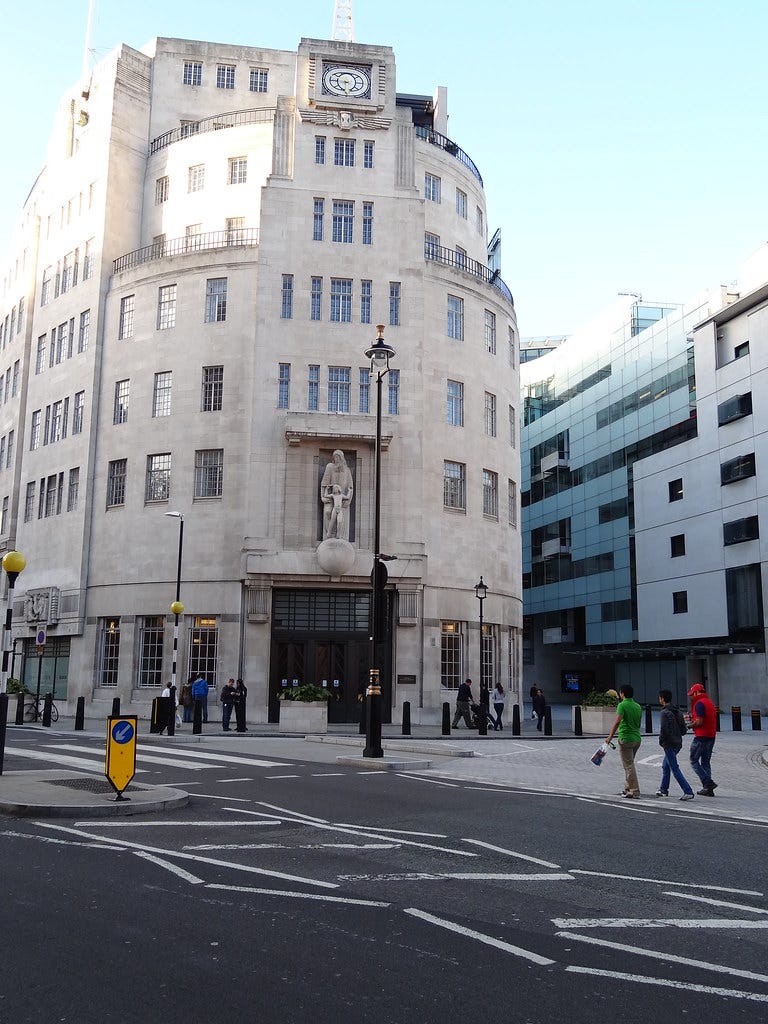
Is it coincidence that a building adorned with pedophile sculptures should be found to house a nest of pedophiles?
First — are these ‘pedophile sculptures’? Or merely sculptures carved by a pedophile? Do they have a pedophilic subtext, or are we imagining it based on what the sculptor confided to his diaries?
There appear to be five of them in series. In their titles, they allude to characters from Shakespeare’s music- and magic-soaked romance, The Tempest. It’s a charming entertainment for a daughter’s wedding, full of mystery and spectacle, incorporating a masque — a show-within-the-show, combining acting, singing, and dancing with fantastical costumes and stage effects. The editors of the first collected edition of Shakespeare’s plays, the First Folio (1623), gave it pride of place at the front of the book, presumably because of the evocative theatre-metaphor it uses and its clearly autobiographical central character. Behind its spectacular effects lies an intriguing allegorical structure of ideas, and although it is not one of Shakespeare’s most famous plays it has influenced many other writers, provoking literary allusions and variations as diverse as W H Auden’s Caliban on Setebos, T S Eliot’s The Wasteland, Sylvia Plath’s Ariel, John Fowles’ novels The Collector and The Magus, and of course Aldous Huxley’s Brave New World.
The Tempest tells the story of Prospero, an exiled ruler who transforms himself into a powerful mage in order to regain his kingdom. With him, stranded on a deserted island, is his daughter Miranda, who in Act V utters the words lifted by Huxley for the title of his satirical dystopia: ‘O brave, new world, that hath such people in it!’ Prospero’s only other company is a semi-human monster — Caliban — whom he found on the island, and Ariel, a daemon or elemental spirit whom he released from imprisonment inside a tree, in exchange for twelve years’ service.
As an immaterial spirit, Ariel’s power is not physical but psychological, spiritual, perceptual. He creates illusions; that is all he does. Even the terrible storm with which the play opens turns out to have been a mass hallucination. Ariel’s hypnotic power is evoked throughout by music, and Gill highlights this, the flute held by Ariel in the first piece recurring in all of the others. Through Ariel, Prospero can make people fall in love, fight each other or kill themselves. He can destroy his enemies without ever revealing himself; but although his temperament has its brooding, vengeful side, he continues to grow spiritually during the action and ultimately — prompted by Ariel — foregoes the vengeance he is in a position to exact. The play ends happily, in marriage, the forgiveness of old feuds, the reunion of lost children, fathers, brothers and friends, and redemption of the self ‘when no man was his own’.
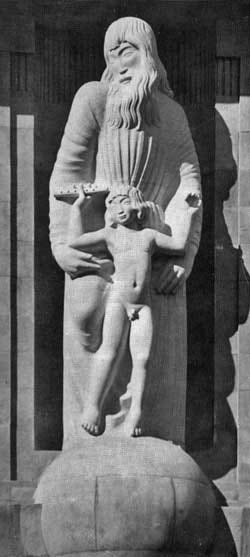
The sculpture which attracts most attention at Broadcasting House is ‘Ariel and Prospero’, because of its prominent position above the main entrance to the original building, on its South face. Gill portrays Ariel as a small, naked boy, though at the same time a colossus, his feet resting on the globe. With his hands lifted above his head, he leans back against the robed Magus who towers behind him, eyes closed, a beatific expression on his face. Not just the boy’s nakedness but Prospero’s posture and facial expression are somewhat ambiguous. The effect is subtle, and you might wonder if it’s all in your imagination — that is, until you consider this piece in the context of the whole series.
The question here is — why is Ariel shown as a naked child? He never takes the form of a child in the play, although he does have a childlike curiosity about human nature which might perhaps suggest such a representation. His nakedness can be glibly justified in terms of classical traditions, as in the cherubs that adorn medieval and renaissance art. On the exoteric level, Gill in 1932 seems to be evoking the infancy of these magical new technologies, radio and television, which will one day ‘bestride the world’, to borrow another Shakespearean phrase. So this piece, in and of itself, has artistic justification, though according to the book I consulted, ‘Broadcasting House in the Nineteen Thirties’, Gill was forced to tone down aspects of the work he had completed for the building as a result of objections at the time. One of the alterations was to reduce the proportions of the phallus with which he had endowed his Ariel figure. Anecdotes recall his working on ladders dressed only in a long coat, and female employees being instructed not to look up as they entered or left the building.
The book lists three other pieces in the series, located on the West, East and North fronts of the building, but an online image-search reveals five pieces in all. Ariel is seen to grow and mature throughout the sequence.
In Shakespeare’s play, magic is explicitly a metaphor for theatre, the powerful new art-form of the English Renaissance, itself a revival and evolution of the theatre traditions of ancient Greece and Rome, and Ariel commands the magical special effects that entrance the audience. It’s a simple step for Gill to stretch the metaphor to the new broadcast media, with Ariel representing the immaterial propagation of radio waves.
In the first two pieces we see a visual embodiment of this technological metaphor, the angels’ folded wings echoing those of the heraldic eagles on the BBC’s coat of arms, the arrangement of their feathers evoking radiating electromagnetic waves.
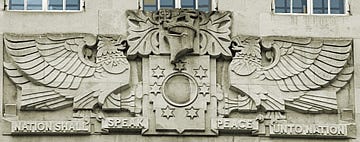
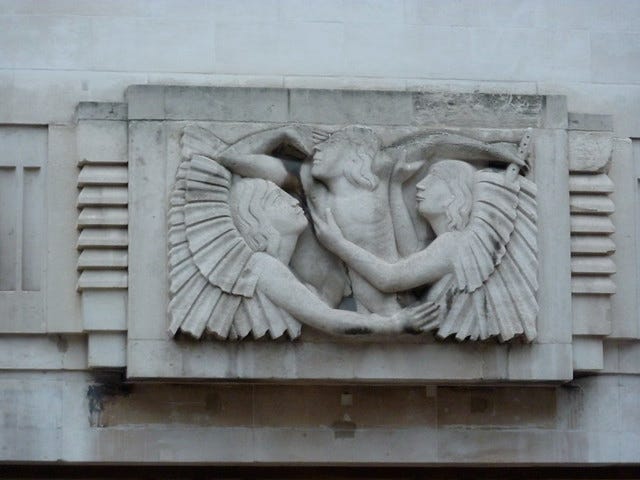
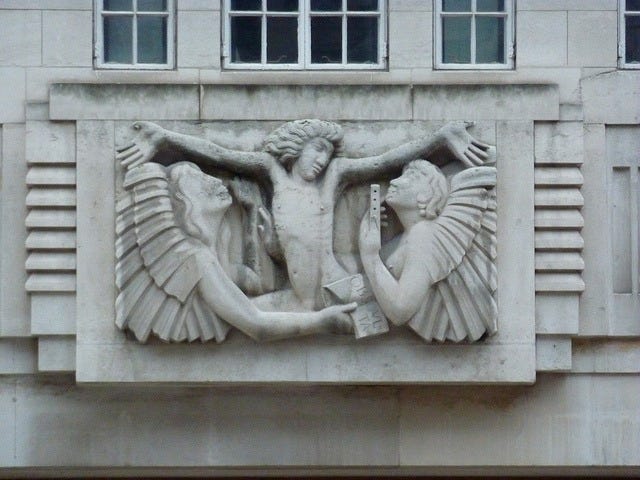
These two pieces by Gill, both entitled ‘Ariel Between Wisdom and Gaiety’ (reflecting the BBC’s charter-obligation to inform and educate as well as entertain) follow the visual structure of the coat-of-arms. The second of the pair is located above the bookshop windows at street level. I’m not sure of the location of the first; the book accords it pride of place above the concert hall entrance on the North side, but Wikipedia gives that place to the last piece in the series, which would make more sense. In the first of the two it looks as if Wisdom’s right arm has been clumsily extended to take the hand away from where it would otherwise rest, and it makes sense to speculate that this version was replaced by the second, as another of the alterations Gill was forced to make to ‘tone down’ these blatantly sexual images?
In the original, Ariel’s face is turned towards Wisdom; in the second piece, towards Gaiety, who is holding Ariel’s flute in front of her mouth in a gesture reminiscent of the sign of silence. Wisdom’s left hand performs a similar gesture in front of her own lips. In her right hand, she holds an open book with the latin word OSCULTA — Listen! — inscribed across its pages.
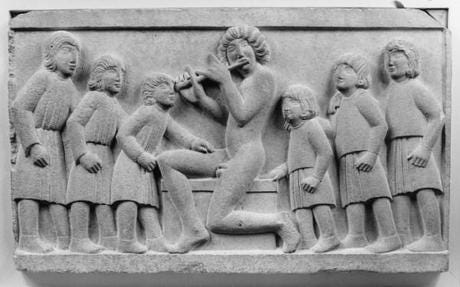
The last two pieces in the series focus on the psychological power of music, dramatising its hypnotic effect. From my brief research I’m not sure where this fourth piece is located on the building or what its title is, but again it is a highly dubious visual image. Ariel, still naked, is now the largest figure in the tableau. On either side of him is a group of three figures, which seem to represent archetypal family groups of man, woman and child. Ariel is seated in the centre, naked, playing his flute. All six of his listeners gaze at him, entranced. On each side, the child of the family is closest to him and reaches out a hand…
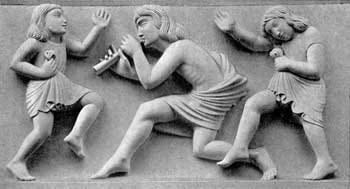
In the final relief, Ariel is fully grown, a physically powerful figure now, and he has finally put some clothes on. The most important thing in this image is that the adults have disappeared. In a superficially innocent, exuberant image, the two children are completely under the power of Ariel’s music, dancing on either side of him and bunching up their skirts in their hands. Ariel’s stance both complements and contrasts with that of the children — he is not dancing but conducting the dance, embodying focused purpose, not abandon.
So what are we looking at in this series of sculptures? A surface text relating to the the media of radio and television and a subtext reflecting Gill’s secret life? Or are text and subtext inextricably bound together in a more generalised psychopathic scenario?
On the surface level, a powerful new technology is shown even in its infancy bestriding the world. In its maturity we see it dissolving the family, making the adults disappear and entrancing the children. The whole allegory is centred around music, just as the building is itself centred on an internal tower of cantilevered studios using state-of-the-art architectural strategies to isolate them from city noise as well as sound from other studios. BBC radio, of course, broadcasts not only music but spoken word and drama, but the music motif of the sculptures can be taken as symbolic of the psychological power of the new medium as a whole, not only its light entertainment wing. Even without the perverted subtext, the series reads like a parable of social engineering, the induction of a hypnoid trance that leaves its subjects isolated and vulnerable. The innocent surface text about the power of the new media is not elaborated merely to veil the subtext — the allegory is sinister on both levels.
The dramatist who used the name ‘William Shakespeare’ wrote his play for a daughter’s wedding. Prospero guards the honour of his young daughter fiercely, and everything he does, we understand by the end of the play, is motivated by his care for her future. Look at her the wrong way, and the mage will paralyse you, hunt you with spirit dogs, terrify you with visions of hideous winged furies and drive you to the brink of madness.
By contrast, Gill’s variation on the theme is characterised by a kind of sinister frivolity, which reminds me of something, I don’t know, maybe a track-suited procurer in a blonde wig, chomping on a fat cigar. Jimmy Savile was five years old when the building was opened. His key to the kingdom would be music; children deprived of protection would be his prize. Before his time was over, the BBC would become notorious for reporting on an event before it happened. In his Broadcasting House sculptures, we might say that Eric Gill somehow achieved the same feat. Like Savile, Gill seems to have enjoyed flirting with confession, lifting the mask teasingly, toying with exposure. The occult practice of hiding in plain sight gives the sociopathic artist a sexual thrill.
Perhaps it is true that what happens within a particular space depends on the kind of invocations that are made around and within it. Walk in under that statue mounted above the entrance like a tutelary deity, and you’ll find yourself in an art deco lobby. Here you will see a sixth piece by Gill, standing alone.
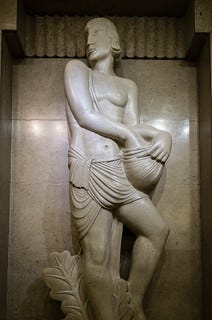
It’s called ‘The Sower’, and constitutes Eric Gill’s foreshadowing of the growth of a sick culture which ate the institution out from inside, turning it into a leering parody of all it was supposed to stand for.
Or maybe it was there from the start.
Thanks for reading The Lethal Text! This post is public so feel free to share it.
You can support my work at:
https://ko-fi.com/thelethaltext.
All contributions much appreciated!
This is a magisterial reading of Gill’s public sculpture series at the artistic level (details of what we see and their organization), the cultural/political level (symbolic meaning), and the historical level (manifest and occulted context). To introduce the analysis in the time and space of the covid lockdown protests is an inspiration.
I hadn’t heard of Clement Freud, only his brother Lucian (speaking of lurid imagery) and their cousin Edward Bernays, the maestro of modern media propaganda and mass mind control.
I suppose it’s been known for millennia that the easiest, fastest and crudest way to control people at any scale is through traumatic victimization, preferably starting in childhood aka pedophilia, or abuse of older targets by infantilizing them.
The puerile Ariel figure’s musical iconography is instructive, in the sense of “Clockwork Orange”’s (both novel and film) twisting of Beethoven to torture and program young Alex. I trace music’s power to seduce — as well as to induce/incite — to the fact that it’s the only art that physically touches us via moving waves of air, especially in the lowest bass register. The effect is magical, spooky action at a distance.
No wonder that Plato and strict caliphates confine it to marches and patriotic hymns. The flute held by Gill’s Ariel is phallic in shape and use — lips, fingers, mouth, tongue: a “blow” job — and in my homosexual orbits, the penis is coded as “skin flute”.
You’re surely right to allegorize Ariel’s musical medium as the media in general — radio, television and now internet. It is thus the BBC itself (and all government-corporate communications) astride that globe, which in the setting of “The Tempest” makes me speculate how Shakespeare’s Globe Theater prefigured globalism (“the sun never sets on the British Empire“). As we’ve discussed already, the Bard is a locus classicus of covert identity (de Vere, Bacon, maybe both and/or others?) and state intrigue.
In the age of Epstein, politics perversion and plague come together in your excursus that documents the masonic practice of revealing its own method in order to display power and subdue victims.
Ariel sounds like a form of god of flocks and herds like Pan, meaning All. Peter Pan, and the Pied Piper with his flute comes to mind too. Pan was known for his sweet music and sexual desires, an allegory for "overcoming the goat/animal nature" as he was a God-Man in his higher nature.
Pan was known to strike terror in people who saw him (meaning Ultimate Reality) and the last 100 years has been a Palace of Illusions on steroids. This is all to say that BBC, Saville, Epstein and Co.'s exposure illustrates the inner differences between people the way nothing else could.