
THAT FACEHUGGER MASK
Have you got to THE SCENE yet?

A COVID mask in the shape of H R Giger’s ‘facehugger’ creature? The idea came to leatherworker James Body right at the beginning of this movie, and by August 2020 he was marketing them through his Pirate Leatherworks operation based in York, UK. I didn’t come across photographs of it until about three years later. But what a brilliant concept. After all, as Nerdist enthused at the time, ‘It combines the safety we need with the horror franchise we love!’
I’ll never forget the first time I saw Ridley Scott’s Alien. In 1979 I was in London, studying for a PGCE at a college in Richmond, and having a free afternoon I took a train into the city to watch a movie. I’d been attracted by those posters featuring that weird xenomorphic egg and the tag-line In space, nobody can hear you scream, which established the suffocating tone of Ridley Scott’s science-fiction horror film, and I don’t mind admitting that I watched a lot of it through splayed fingers. You have to remember how new the genre was, how gritty and realistic in comparison with what had come before — it seems incredible that it was made only a few years later than a film like Logan’s Run, or Star Wars for that matter. I suppose it also didn’t help that I was watching it in a huge and almost deserted cinema in Leicester Square.
The horror was seeded not just by the grisly special effects; it was as conceptually creepy as it was visually shocking. H R Giger’s biomechanistic designs, both of the creature’s parasitic life-cycle and of the eerie, visceral interiors of the wrecked alien spaceship, were unforgettably disturbing. There was something about the whole production that utterly spooked me, and musing later about the power of its effect I wondered if it was explained by our deep-seated, latent fears of our own bodies and mutative disease. The film was as frightening as cancer. I also remember thinking that I was less afraid of the alien itself than of the minds that could come up with such sick ideas.
Many years later I met one of the writers in Bangkok, where I was working at an international school. I was trialling a new way of constructing a literature course using narrative archetypes, inspired by Christopher Booker’s superb literary taxonomy, The Seven Basic Plots; Why We Tell Stories. I paired the works on the syllabus with other narratives which drew on the same archetypes, to bring out deep themes and structure. So for Comedy (i.e. the love story) I paired A Midsummer Night’s Dream with Avatar, which was all the rage that year; for Voyage and Return, The Great Gatsby with The Wizard of Oz; and for Overcoming the Monster, Beowulf and Alien. An acquaintance happened to know the producer and writer David Giler, who had retired in Thailand. I contacted him and invited him to come and talk to my students, which he did, and he was very interesting and not scary at all. Giler and the screenwriter Walter Hill had adapted the original story by Dan O’Bannon and Ronald Shusett. He’d been sent O’Bannon’s screenplay, which in his opinion was dreadful but contained one extremely powerful scene. Giler relayed the screenplay to the director Ridley Scott, who was looking for a science fiction story for his second film. Scott had a similarly low opinion of the writing and called Giler to complain.
Why are you making me read this rubbish? he wanted to know.
Have you got to the scene yet? asked Giler.
What scene?
Ah, well, said Giler. You’ll know when you get to it.
If you remember, the film opens with the crew of the Nostromo, a huge industrial cargo ship returning through deep space, being woken from stasis by the ship’s computer in order to respond to a distress signal coming from a nearby planetoid. Landing there, they find a derelict space craft of non-human origin, and three of the crew enter it to investigate. In a vast silo, Executive Officer Kane (played by John Hurt) finds strange egg-like pods, and as he bends over to peer inside one of them a creature launches out of it, smashing through his visor and attaching itself to his face. Back on board the ship, Kane is placed under observation in the medical bay. It proves impossible to surgically remove the creature since its blood is so acidic that to do so would endanger not only Kane’s life but the ship itself.
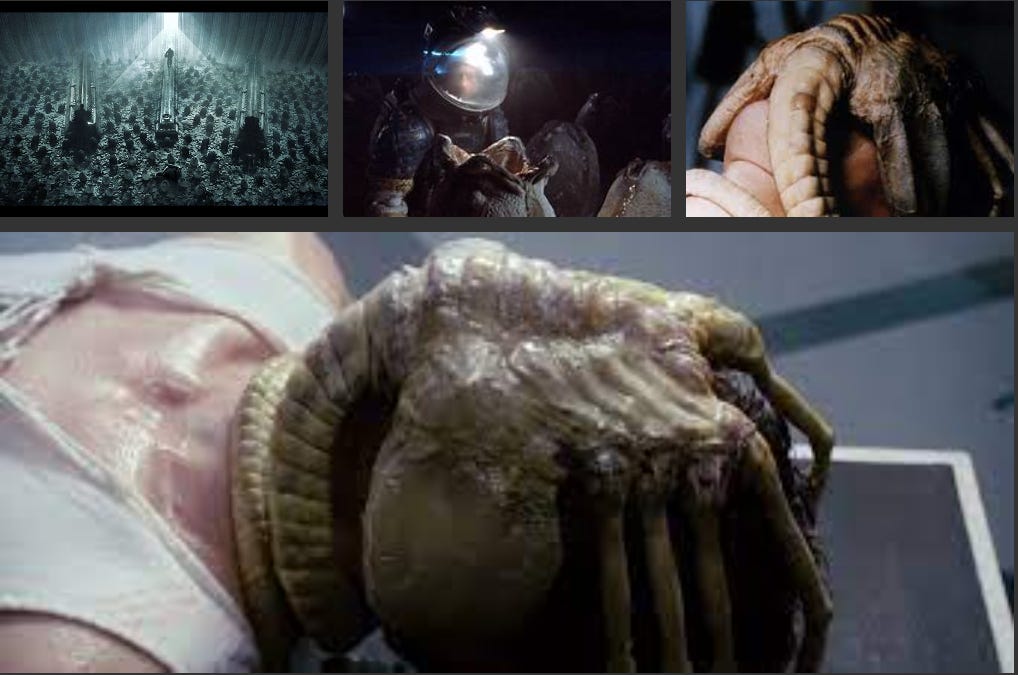
He lies in a comatose state for several days, until it is found that the ‘facehugger’ has fallen off by itself and is lying dead on the floor. Kane wakes up and seems fine. The tension is lifted, and the crew, in celebratory mood, share a last dinner together before returning to stasis for the final leg of their voyage.
And that dinner is the scene which Giler was waiting for Scott to get to in the O’Bannon script. As viewers, we instinctively understand that the tension must be released before ramping it up to even higher levels, so as the astronauts laugh and joke and enjoy their spaghetti, we’re uneasily expecting something to happen — that the threat has to re-emerge. We just don’t know from what direction it will come.
I’m sure you know -- it’s one of the most famous scenes in science fiction history.
The facehugger, we will come to understand, constitutes only one phase of the alien’s life cycle. It has deposited an embryo or larval form inside Kane’s body, where it has been incubating, and now it bursts out through his chest in a scene of extreme, blood-drenched horror.
Giler told me quite frankly that no one was happy with the way that scene looked on screen — the creature moves like the puppet it is, and runs across the wrecked table like a model on tracks. But it didn’t matter — through splayed fingers I was not going to see anything but what they wanted me to see, which was the monster’s brutal attack from the last direction you could possibly expect; that it was inside Kane, growing and transforming, and now ripping through its human host and emerging in imago form.
And the crew sitting down to that dinner, I feel, is where most people still are in our own sci-fi horror movie, which has been playing out for the last six years. Only a fool would think that the movie was over.
The public, jealously guarding its ignorance, remains oblivious to the scale of death and disability caused by the COVID ‘vaccine’. In 2022 the facehugger came off, the tension was released, and attention was abruptly switched to another monster, far away in Eurasia. This interlude has stretched out for four years already. The pandemic is all in the past, they think; the emergency is over; mistakes, no doubt, were made, but all in good faith, and now we’re getting on with our lives. And believe me, I’m grateful for every day of peace and mundanity, and trying to live each one to the full. But my bristling sense of horror has not diminished.
During this interval, global treaties were renegotiated and legislative loopholes closed; censorship provisions were progressively strengthened; mRNA factories were built, and the poison smuggled into the food supply; and we are periodically reminded that we must prepare for the next pandemic. In Bill Gates’ public estimation, Covid was a beta-test, enabling us to expand and refine our public health responses in preparation for what he called ‘pandemic #2’, which ‘will get attention this time (smirk)’.
Like the scene got attention.
Trump got elected. His Warp Speed project, some argued, had pre-empted the original plan to extend the lockdowns for years, collapsing economies and taking us into a totalitarian New World Order, or ‘Great Reset’ as Klaus Schwab of the World Economic Forum had rebranded it. That’s how it felt to me at the time, I have to say — but either way, it meant that the injections were untouchable without destroying Trump politically. Robert F Kennedy did good work reducing the childhood vaccine schedule, but was not allowed to go anywhere near the C19 shot. Pfizer acquired smaller companies specialising in oncology, to take advantage of the boom in cancer. No one was arrested, not Fauci, not Gates, not Bourla or Bancel… by end of 2025 it was clear that the president had been captured, and suggestions that he had converted to Judaism gained traction. Meanwhile his (deliberate?) fumbling of negotiations with Russia, and his steps towards the forced integration of Oceania under a single power-centre, led many to conclude that after abandoning their pandemic scheme the globalists had simply reverted to the age-old war model to achieve the same ultimate ends of hypercentralisation, population control, and the radical restructuring of society.
The mystery shots remained on the market. The deaths continued: heart attacks, strokes, auto-immune disease, hideous neurological disorders, and aggressive, fast-spreading cancers. But there was worse.
The masks were off, but the horror, when it re-emerged, would come from inside.
Have you got to the scene yet?
In January 2022, just as the UK government made its surprise U-turn and began dismantling its COVID restrictions, an embalmer in Alabama USA went public about the strange white bloodclots that had been obstructing the process of embalming some of the corpses he was asked to prepare over the past few months. Over time, other embalmers and funeral directors began to speak up. Whereas standard procedure had always used a single entry point into the vascular system to drain a body of blood and replace it with embalming fluid, now multiple entry points were often needed. With some cadavers, the process was proving impossible to complete.


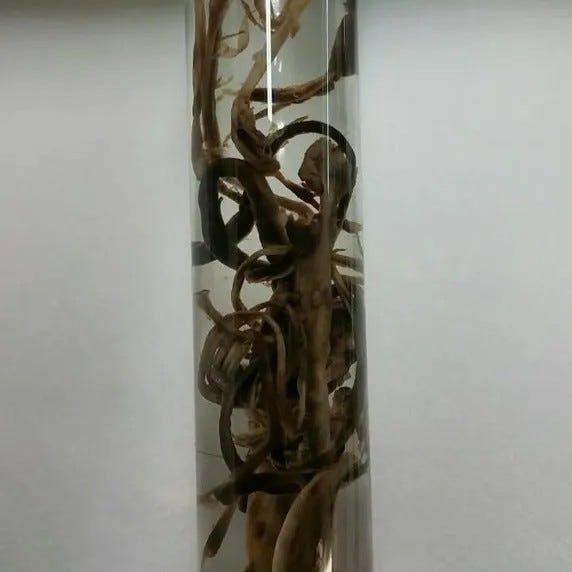
The clots were white when rinsed, rubbery, tensile and resistant to solvents. Early descriptions compared their consistency to calamari. They retained the shape of the artery or vein from which they were taken, and in extreme cases could measure up to 19 inches. In a 2024 world-wide survey of embalmers, 83% of respondents reported finding similar white fibrous clots in (on average) nearly a third of their cadavers. Soon, doctors started finding them in living patients as well. Obviously, the growth of such clots would slowly and surely obstruct the vascular system, depriving the body of blood and oxygen, effectively strangling the host from inside.
There’s always a bigger monster. In Beowulf, after the hero has destroyed Grendel, the monster which night after night has been preying on the villagers, he discovers that the nightmare is not over. There’s a second monster — Grendel’s Mother — the adult form, far more dangerous. Grendel was just an adolescent; it is his parent, who waits in her underwater lair, that almost defeats the hero in the final battle.
By coincidence, the central computer that controls the Nostromo’s systems and takes care of the crew is known as ‘Mother’. It was Mother who detected the distress signal and woke the crew, Mother who allowed the stricken Kane back on board, Mother who enforces company policy.
In the discussion following David Giler’s talk to my class, I had let things flow for some time before dropping in any reference to Beowulf, the Old English epic poem which was, after all, the set text. I explained to Giler that our course was structured around narrative: not just text, but plot, story and archetype, and that I was trying to use Alien to focus minds on the structure and themes of Beowulf.
Giler approved: I’m very much a narrative man, he said. But Ridley Scott, he added, really isn’t. What he meant was that rather than simply telling the story, Scott would get new ideas about it during filming, often very late in the process, and this could make things difficult, to the extent that they had to write and film extra scenes post-production in order to make sense of his revisions. One of these changes concerned Science Officer Ash, played by Ian Holm. Mother, it transpires, is following a secret company directive to ensure that the ship returns to Earth with the alien on board, regardless of the safety of the crew. Her tool is Ash, who, it turns out, is not human but a humanoid robot placed among the unsuspecting crew. When Warrant Officer Ripley (Sigourney Weaver) accesses the computer and discovers the secret directive, Ash tries to kill her. Another crew member, the powerfully built engineer Parker, saves her life by literally knocking Ash’s head off, exposing the robot’s inner circuitry. In a haunting scene added post-production, Ash’s disembodied head speaks.
Ripley: Ash, can you hear me? [slams her hands down on the table] Ash?
Ash: [awakens and starts speaking in an electronic and distorted voice] Yes, I can hear you.
Ripley: What was your special order?
Ash: You read it. I thought it was clear.
Ripley: What was it?
Ash: Bring back life form. Priority One. All other priorities rescinded.
Parker: The damn company. What about our lives, you son of a bitch?
Ash: I repeat, all other priorities are rescinded.
Ripley: How do we kill it, Ash? There’s gotta be a way of killing it. How? How do we do it?
Ash: You can’t.
Parker: That’s bullshit.
Ash: You still don’t understand what you’re dealing with, do you? The perfect organism. Its structural perfection is matched only by its hostility.
Lambert: You admire it.
Ash: I admire its purity. A survivor... unclouded by conscience, remorse, or delusions of morality.
Parker: Look, I am... I’ve heard enough of this, and I’m asking you to pull the plug.
[Ripley goes to disconnect Ash, who interrupts]
Ash: Last word.
Ripley: What?
Ash: I can’t lie to you about your chances, but... you have my sympathies.
— Transcript, Alien (1979)
The emergent backstory, then, is that the alien, whether a natural life form or an engineered bioweapon in some intergalactic war long ago, eradicated the entire crew of the derelict alien ship. Now the company wants to acquire a specimen, to study and adapt to its own purposes, and this specimen is of far greater value to it than either the Nostromo’s cargo or the lives of its expendable human crew.
So I asked Giler a deliberately naive question, trying to bring the class back to thinking about the set text. In Beowulf, there are two monsters; the second worse than the first. In Alien, there is only one, but there is bigger monster protecting it, and that monster is the corporation itself, inhuman in its psychopathic pursuit of profit and power — ‘all other priorities rescinded’. Was that the film-makers’ intention?
Oh yes, said Giler. Absolutely — looking at me as if it was too obvious to need any elaboration. I hadn’t left him much to say, and I realised I should have framed it as open question. But the point was made, and I could see two or three students nodding in concurrence. It was a bookmark we could return to in our next class, when we would discuss the archetype of the monster, the qualities of the monstrous.
I taught at that school for six years, leaving in 2013. Seven years later, as the lockdowns dragged on, a handful of the students I taught there got in touch with me to thank me for opening their minds and teaching them to have questions. Not many, but for every one who wrote, there must have been more who had the same thought but not my contact details. Maybe my influence saved some of them from making the terrible mistake that so many made the following year.
It was that leather facehugger mask that brought all this back to mind as the COVID frenzy faded from memory and the war system reasserted itself.
But in my mind’s eye I was seeing, not the embryonic creature bursting through the chest-wall of the unfortunate Kane, or the saliva-dripping teeth of the adult alien, inches from Ripley’s face; I was back in that vast, misty silo, filled with thousands upon thousands of eggs.
FURTHER READING ON SUBSTACK
Laura Kasner, Clotastrophe. Results of the 2014 World-wide Embalmer Blood-clot Survey
Vesa Reports, White Clots — Overview; A Call to Action
Dr Phillip McMillan, Understanding Embalmers “White Clot Syndrome”
Kevin W McCairn PhD, Cadaver “Calamari” Amyloidogenic Fibrin Aggregates
Bravo. That is what I want to read. You have deftly gotten to an essence here. The choice of subject is powerful. Alien has become mainstream, yet you give it a strange new relevance to the actual horror we are living through. Brilliant.
The facehugger mask elides internal covid injection harms (clots, cancer, death) with the external entities (military, medical, corporate) that imposed the injuries. The mask obliterates individual faces and hides the parasitical monster administering the syringe that penetrates what K Schwab called “the skin barrier”.
The analysis you’ve done is both brilliant and true.